

If you are reading this and feeling afraid, isolated, or unsure of your next steps, please know this: you are not alone, and the abuse is not your fault. We’re here to help you recognize the patterns of abuse, find specialized support near you, and start a plan to leave the abusive relationship safely.
Key Takeaways
- Abuse in a relationship is a systematic pattern of behavior used to maintain power and control—that often moves in a predictable cycle.
- Domestic violence does not discriminate based on race, income, or gender. However, societal myths often prevent people from seeking help.
- The decision to leave an abusive relationship is complicated by factors that increase a survivor’s risk, including financial abuse and the use of children.
- If you are planning on leaving, experts recommend mapping out a “Safety Plan”, rather than a sudden exit.
- If you’re in the Lake County or Chicago area, you can reach out to organizations that provide confidential counseling, legal advocacy, and emergency shelter.
Leaving an abusive relationship is often the most dangerous time for a survivor. At Ammirati Counseling, we believe that knowledge and strategic planning are the most powerful tools for reclaiming your safety and your life.
This guide is designed to help you understand the dynamics of abuse and provide expert-backed steps to exit a dangerous situation as safely as possible.
Understanding the Mechanics of Abuse
Abuse is rarely a series of isolated “bad days.” It is a systematic pattern of behavior used to maintain power. Experts often use two primary models to explain this:
The Power and Control Wheel
Developed by the Domestic Abuse Intervention Project, this model shows that physical (and often sexual) violence is just the “outer rim” used to reinforce various tactics of control (National Domestic Violence Hotline, 2026).
These tactics include:
- Emotional Abuse: Name-calling, gaslighting, or making you feel or think you are “crazy.”
- Isolation: Controlling who you see, where you go, and what you do.
- Economic Abuse: Preventing you from working or controlling your finances.
- Coercion and Threats: Threatening to hurt you, themselves, or report you to authorities.
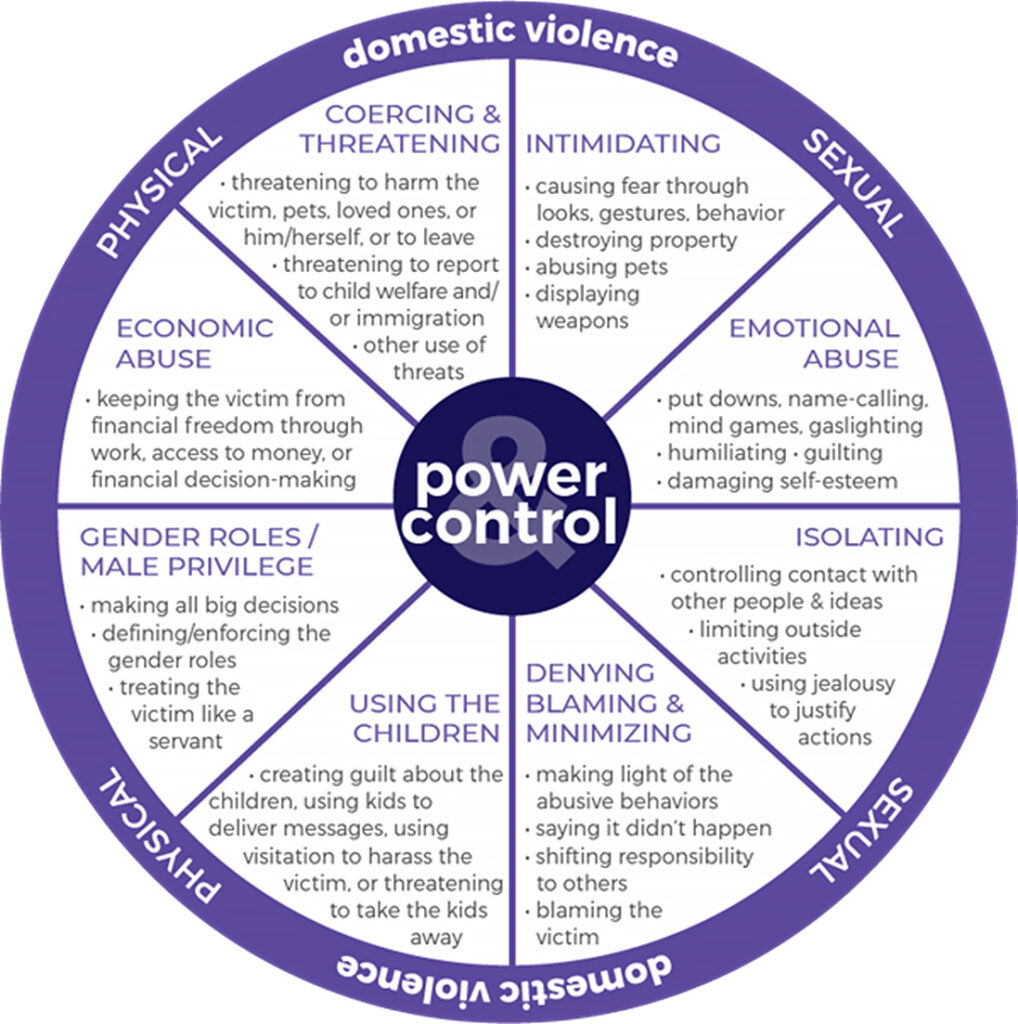
The Power and Control Wheel [Credit: Respond, Inc.]
The Cycle of Violence
Abuse often moves in a predictable cycle:
- Tension Building: A period of tension, often feeling like “walking on eggshells.”
- Incident: The verbal, physical, or emotional outburst occurs.
- Reconciliation/Honeymoon: The abuser apologizes, gives gifts, or promises it will never happen again. This phase often keeps survivors hopeful that things will change.
Statistics and Debunking Myths on Abusive Relationships
Domestic violence does not discriminate based on race, income, or gender. However, societal myths often prevent people from seeking help.
The Reality: According to the National Domestic Violence Hotline, an average of 24 people per minute are victims of physical violence, rape, or stalking by an intimate partner in the U.S. (NDVH, 2026).
Myth: “Only women are victims of abuse.”
Fact: While nearly 1 in 3 women experience domestic violence, approximately 1 in 4 men also experience physical violence or stalking. Furthermore, psychological aggression is experienced nearly equally by both men and women, with about a 48% lifetime prevalence for each gender (National Domestic Violence Hotline).
Myth: “If it’s not physical, it’s not abuse.”
Fact: Emotional, verbal, and financial abuse can be just as damaging and are often precursors to physical violence (WomensHealth.Gov).
Safety Considerations and Barriers to Leaving an Abusive Relationship
The decision to leave is complicated by factors that increase a survivor’s risk.
The Impact of Financial Abuse
In 99% of domestic violence cases, financial abuse is present. Abusers may ruin your credit, hide assets, or prevent you from having a bank account.
This “economic trap” is the primary reason many survivors return to their abusers—they simply have no way to pay for housing or food.
The Role of Children
Abusers often use children as “pawns,” threatening to take them away or using visitation as a way to continue harassment. This creates a profound emotional barrier, as survivors fear for their children’s safety or worry about the legal repercussions of leaving with them.
Expert Best Practices for Leaving an Abusive Relationship Safely
If you are planning to leave, psychology experts and advocates recommend a “Safety Plan” rather than a sudden exit.
- Keep a “Go-Bag”: If safe, hide a bag with extra keys, cash, and copies of important documents (ID, birth certificates, insurance) at a trusted friend’s house.
- Digital Privacy: Use a computer at a public library or a friend’s phone to search for resources. Abusive partners often monitor browser history and GPS locations.
- Establish a Code Word: Choose a word or phrase to text a friend or family member that signifies you need them to call 911 immediately.
- Consult a Professional: Speak with a domestic violence advocate who can help you navigate the legal system and find temporary shelter.
Local Resources: Lake County & Chicagoland
If you are in the Lake County or Chicago area, help is available right now. These organizations provide confidential counseling, legal advocacy, and emergency shelter.
Lake County Resources
A Safe Place (Zion/Waukegan):
The leading provider in Lake County for domestic violence services.
- 24-Hour Help Line: 847-249-4450
- Website: asafeplaceforhelp.org
Community Crisis Center (Elgin/Northern IL):
Provides emergency shelter and 24-hour crisis intervention.
- 24-Hour Hotline: 847-697-2380
Chicagoland Resources
Between Friends (Chicago):
A non-profit dedicated to breaking the cycle of domestic violence through counseling and legal clinical services.
- 24-Hour Hotline: 800-603-4357
- Website: betweenfriendschicago.org
Life Span (Chicago/Des Plaines):
Specializes in legal services and advocacy for survivors.
- Phone: 312-408-1210
Illinois Domestic Violence Hotline:
- Call or Text: 877-863-6338
If you are in immediate danger, please call 911. You deserve a life free from fear, and there is a community of professionals ready to support your journey to safety.