

By Claire Manley
Blended families can be challenging—marked by tension, divided loyalties, and the fear of ‘doing it wrong’—and stepparenting after divorce can add even more complexity. Between conflict, emotional distance, and balancing everyone’s needs, it’s easy to feel unsure of what to do. Here are five tips to help guide you.
In my career, I’ve seen countless variations of blended families. Coming to therapy as a blended family is a great start, and I admire any family that is willing to work constructively on issues they’ve faced after a stepparent joins the family.
However, just as couples tend to start couples therapy, on average, about four years into their relationship (with many wishing they could have started counseling earlier), blended families tend to initiate therapy after problems have festered for some time, which can make work in therapy more difficult for all (Boudin, 2022).
The good news is this: blended families can benefit immensely from therapy at any stage of the family’s life.
Whether you are a new stepparent or a parent of children who have experienced divorce, the tips for each of these roles apply to encourage communication and alignment in your goals towards a happy blended family.
5 Stepparenting Tips for Healthy Relationships in a Blended Family After Divorce
Tip 1: Avoid Speaking Negatively About the Ex
Disparaging your partner’s ex will come back to bite you. Respect, boundaries, and healthy co-parenting will nourish your blended family substantially.
As a potential stepparent, your partner who has children from a divorce will likely have many frustrations about their ex. They got divorced for a reason. It may be tempting to align yourself with your partner against their ex, becoming your partner’s cheerleader when they complain about their ex’s behavior, parenting, or ways they feel undermined.
To use a driving metaphor, your goal as a couple and family is to move forward. You cannot build a solid foundation for a blended family by staring in the rearview mirror. In fact, that can be very dangerous.
If your partner vents frequently about their ex, you, as a potential stepparent, can validate their feelings and remind them that your goal is to maintain a cordial relationship with the other parent.
As Ron L. Deal, author of The Smart Stepfamily, writes, “Negative comments about [a parent’s behavior] flow out of frustration or hurt, but sometimes are an attempt to keep your children loyal to you. Parents don’t realize they already have their children’s loyalty; a stepparent will not replace a biological parent in the child’s heart. Negative comments are simply unnecessary. In other words, unwholesome talk about the other home is an effective form of self-sabotage” (Deal, 2014, p. 55).
Tip 2: Building Trust Slowly
Building solid relationships with stepchildren is a marathon, not a sprint.
Both the parents of children of divorce and the potential stepparent may be tempted to lead the way in announcing their relationship to the children. A potential stepparent may feel dismissed when they express concern about their partner’s children appearing disinterested when they first begin spending time with them.
Here’s the difficult truth: both the biological parent and the new stepparent need to earn the trust of children of divorce, just as one would in any other relationship.

Trust takes time. In addition, your children of divorce already have a second parent. So, they may display anxiety, guilt, or apprehension when trying to connect with a new parental figure because they feel loyalty to the other parent.
Deal writes, “Stepfamilies generally don’t begin to think or act like a family until the end of the second or third year,” and it may take “the average stepfamily around five to seven years to integrate sufficiently to experience intimacy and authenticity in step relationships” (p. 60).
Patience, communication, alignment, and authentic bonds that are consistent over time always win out over gifts, grand displays, or control.
Tip 3: Validating the New Stepparent’s Experience
The new stepparent joining the family will have a unique perspective. This gives you, as a couple, a great opportunity to support healthy shifts in a family dynamic.
However, prepare for times where the new stepparent will feel jealous, left out, or “overruled.” Here’s how you can handle these experiences:
Imagine this: You and your partner have worked hard to build consistency in spending time together with your partner’s children. You hoped to spend time with your stepfamily over the holidays, but one of your partner’s children is ill. So, you agree to do a movie night together, as you haven’t had time alone with your partner in a week.
Then, you watch as your partner’s sick child is doted on, wrapped in blankets as they snuggle up and hold their parent’s hand. It is normal to feel a twinge of jealousy when your partner is snuggled up with their child after you haven’t been able to touch your partner for a week.
Allowing yourself to feel, acknowledge, and ideally process that jealousy with your partner while you two have some time alone will help you develop healthier ways to cope with those feelings together.
Having a partner who can recognize your perspective as you integrate into their family system is critical. By communicating these feelings rather than holding them in, both of you will be better equipped for authentic family intimacy when plans inevitably change. Take these moments to learn more about yourself and grow together as a family.
Here’s another situation where unique perspectives can lead to a better connection with your stepfamily: You are the parent of two children and share 50% custody with your ex. You and your partner are eager to spend Christmas morning with the kids. Your child opens their gift from your partner – you can’t wait to see their beaming smile. Instead, they start to cry and share that their other parent already got them this gift. Here is that innate loyalty to the other parent coming into the picture.
There is no “perfect way” to handle this. Still, some suggestions include:
- affirming that your child’s present from your ex is important;
- deciding to have a conversation with your ex about coordinating gifts more effectively in the future;
- encouraging a “shared experience” with the duplicate gift by suggesting your partner’s gift remain at your home. In contrast, the gift they got from your ex will stay at your ex’s home.
What is important is to empathize, problem solve, and identify ways to show you’re supportive, not opposing.
A new stepparent will likely see dynamics that cause tension, stress, or frustration uniquely as an outsider joining the family. It is important that you and your partner can hear each other’s feedback, and that you both remain flexible with strategies moving forward, so these dynamics can soften over time.
Tip 4: Balancing Couple Time and Family Time
“Coupleness” does not necessarily translate into “familyness.” These are separate processes.
As a potential stepparent, when you first learned that your partner had children, what was your initial feeling? Many might romanticize the idea of becoming a blended family with their partner and their children, fantasizing about all the possible high points in a happy family’s life.
Inversely, you may have feared the responsibility of stepparenting and assumed you’d be “adopting” your partner’s children into your relationship from the start.
Whether your reaction was happy or fearful, it is best to establish a “couple identity” with your partner that is solely between the two of you, while being mindful that the “family identity” will be a separate and parallel process.
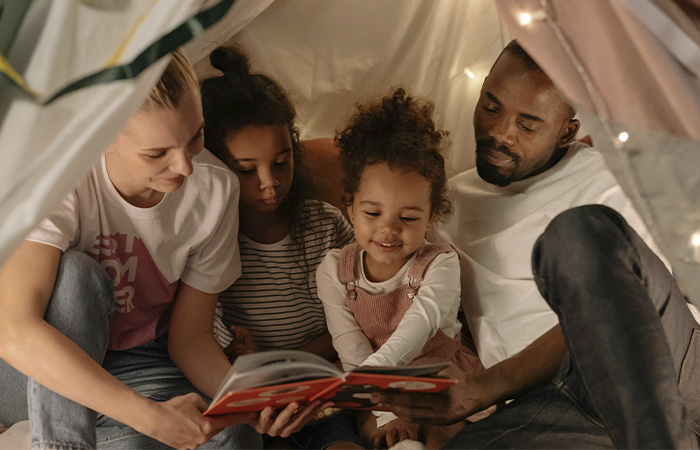
Successful stepfamilies embrace both factors: “coupleness” and “familyness.” They invest their time and energy separately into these categories.
For example, you can schedule date nights, mini-vacations, and alone time with your partner as you develop your relationship, so you have a solid foundation as a couple. As you both get comfortable with a future blended family, scheduling movie nights, family game nights, or Sunday dinners with the children is equally important for a “familyness” foundation.
Children of divorce must be the priority when considering dating and the journey of stepparenting. As Ron Deal writes, “I discourage dating if one child is struggling with emotional issues (anger or defiance, depression or anxiety) … These children need a focused, available parent, not one dividing their time. Help your child through a difficult season and then open yourself up to romance.”
Timing really is everything, and it takes a responsible and caring couple to know when to pump the brakes and center a child’s needs.
Tip 5: Honoring the Child’s Grief
Don’t ignore the elephant in the room: grief. It is far better to accept that children of divorce will require extra support, trust, and consistency from a stepfamily.
Children who have experienced divorce will undoubtedly, in some way, continue to grieve the loss of a dream: the dream of a family where their parents are still married. Even if many years have passed, children have an innate wish to see their parents together again (Deal, p. 41).
Deal likens the hard work of a stepfamily to having faith in making it to the Promised Land. This is going to require long-term thinking and plenty of hope. Statistics suggest that it takes most couples in stepfamilies five to seven years to achieve a reduction in stress that is comparable to stress rates of a first marriage (Deal, 41).
Thankfully, research has shown that it is fair to be hopeful about the potential of a blended family or stepfamily.
A healthy stepfamily has been shown to “diminish behavioral problems in children that arise after parental divorce,” and children from healthy blended families often carry a narrative of healing and redemption, which is linked to lower divorce rates when those children grow up and get married.
Additionally, children from a healthy blended family tend to mirror the quality of relationship from the “stepfamily’s healthy marriage compared to the poor-quality marriage that ended in divorce.”
As Deal states, this means that a strong couple can “undo the generational cycle of divorce – in just one generation,” if stepfamilies do it right.
Find Support for Blended Families Navigating Divorce Challenges
Are you struggling with stepparenting after divorce? If blended family challenges feel difficult to overcome, you’re not alone. Many families wait to seek therapy until problems have built up—but it’s never too late to create healthier, stronger family relationships.
Our therapists provide family therapy tailored to blended families and divorce-related challenges. Reach out with questions or schedule a free consultation call here.
About the Author:

Claire Manley, LCPC
Claire is a Licensed Clinical Professional Counselor with a passion for working with children, adolescents, adults, and families, holding space for self-discovery, healing, and lasting positive change.
With over seven years of experience, she specializes in grief and loss, trauma and PTSD, anxiety, depression, divorce, family conflict, ADHD, and more.